2026-08-28
Introduction
Image-guided thermal ablation is an important minimally invasive treatment for early stage lung tumors or lung metastases, particularly for patients who are suitable for surgery. Radiofrequency ablation (RFA), microwave ablation (MWA), and cryoablation have applications and respective limitations in lung tumor ablation—but they share a common challenge: the ablation margin is invisible. Interventional radiologists cannot precisely confirm whether an adequate ablative margin (A0) has been achieved during the procedure. They must rely on experience and wait for post-procedural imaging to evaluate the outcome. This uncertainty has been the greatest barrier to the wider adoption of precision ablation in the lung. Recently, Xu’s team from the School of Biomedical Engineering at Shanghai Jiao Tong University published a research study in Annals of Biomedical Engineering, a leading journal in the field. Using a porcine lung model, they systematically validated a novel multimodal thermal therapy (MTT) strategy: by pre-freezing the lung tissue with liquid nitrogen, the tissue properties were physically "remodeled", inducing the replacement of alveolar air with blood. This transformed the high-impedance "air-filled lung tissue" into a "parenchyma-like environment" similar to some organ tissue, i.e. liver. Experimental results demonstrated that this strategy significantly reduced tissue impedance, nearly tripled the ablation zone, and substantially improved treatment efficiency. Moreover, the ablation margin became clearly visible on CT imaging, enabling precise control of the effective ablation zone. The results of this research offer a new clinical solution to safe and highly efficient minimally invasive treatment with precision for lung cancer patients.
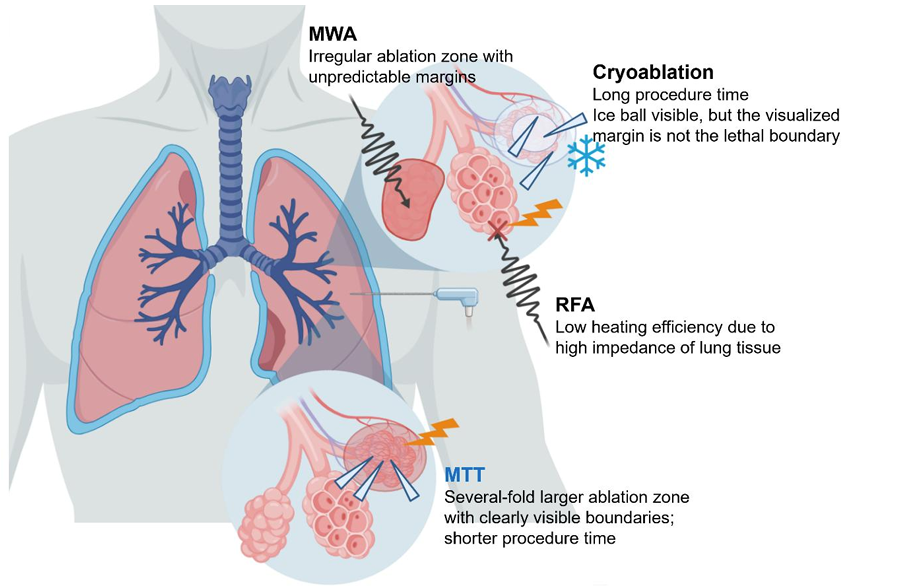
Why Do All Mainstream Ablation Technologies Have "Blind Spots" in the Lung?
Normal lung tissue is rich in air, which acts as an electrical insulator. RFA energy is often interrupted shortly after delivery, resulting in small, poorly defined ablation zones. Although MWA is not limited by impedance, the presence of air still causes the ablation zone to "shrink", making its size and shape unpredictable and difficult to control, raising safety concerns. Cryoablation produces an ice ball visible on CT, but the lethal zone is confined to areas below-40°C. Tissue in the region between 0°C and-40°C at the ice ball margin is "frozen" but not "killed". Interventional radiologists can see the ice ball, but they cannot see where the-40°C isotherm lies.
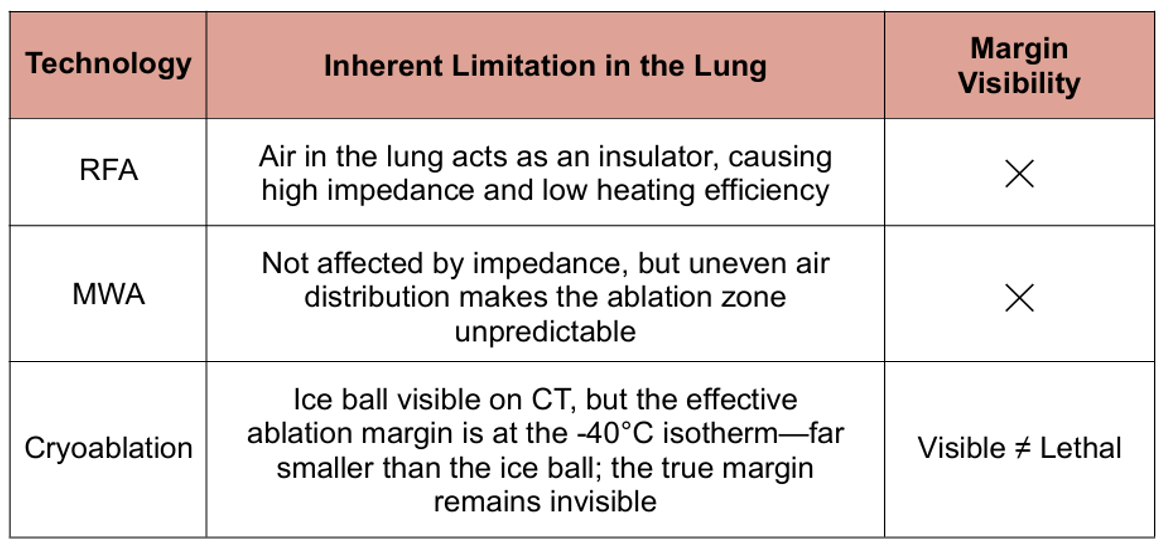 The core dilemma: Thermal ablation margin cannot be visualized; margin visualized in cryoablation is not the ablation margin.
A New Strategy: Freeze First to "Remodel" the Tissue, Then Apply RF to "Lock In" the Margin
The rationale behind this new technology is to first remodel the tissue environment in the target zone, and then apply energy:
- Pre-freezing: Liquid nitrogen rapidly cools the target area to-180°C, forming an ice ball.
- Gas-blood exchange: Freezing disrupts the alveolar microvasculature, causing capillary rupture. Air in the tissue is replaced by ion-rich conductive blood, transforming the tissue from an "insulator" into a "conductor".
- RF heating: RF energy is applied within the remodeled, ice ball–defined "parenchyma-like" environment, enabling efficient, stable energy delivery in targeted area.
Data from the study showed that this remodeling reduced lung tissue impedance by half, nearly tripled the ablation zone, and most critically, the 60°C lethal isotherm of the subsequent RF heating closely overlapped with the pre-freezing 0°C isotherm.
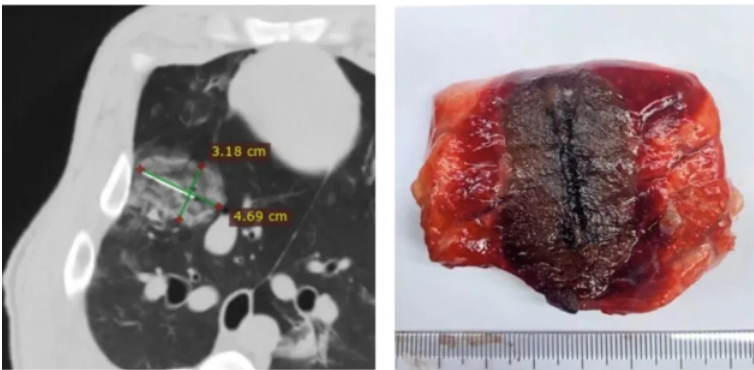
The result: Heating efficiency is significantly enhanced, the ablation zone expands several folds, and the ice ball boundary visible on intraprocedural CT corresponds precisely to the final ablation margin.
Core Advantage: "What You See" is "What You Kill" — Real-Time Margin Assessment
In conventional lung tumor ablation, the interventional radiologists often face the question: where exactly is the ablation margin? MTT allows them to "see" the final ablation zone during the procedure. If the margin is insufficient, additional ablation can be applied immediately, ensuring treatment completeness.
In addition, the "tissue remodeling" strategy offers two further benefits:
- Heating efficiency is substantially improved, nearly tripling the ablation zone. A single-probe treatment can achieve an ablation zone sufficient to cover a 3 cm tumor with an adequate margin, sufficient for T1-stage lung tumors, reducing the number of ablation probes needed and lowering the risk of complications such as pneumothorax.
- Microcirculation in the target area is disrupted, eliminating the "heat-sink effect" caused by blood flow, allowing heat to be concentrated on tissue destruction.
Beyond Ablation: Creating Opportunities for Combination Therapy
During local tumor destruction, the rapid alternation of cooling and heating generates thermal stress that disrupts tumor cells and releases tumor-specific antigens, remodeling the tumor microenvironment and macroenvironment. This helps create conditions for subsequent combination immunotherapy. The synergistic effect of local ablation and systemic immunity is something that conventional ablation techniques alone cannot achieve. The innovative medical device developed based on this principle—the Multimodal Tumor Therapy System—has already been developed by MAaGI Medical, Shanghai, China, and introduced into clinical practice at leading tertiary hospitals. The published expert consensus has provided a foundation for its standardized application in lung tumor ablation.
Conclusion
Compared with the three mainstream ablation technologies, MTT achieves a leap from "invisible" to "visible". For patients with early-stage lung tumors or lung metastases, MTT offers a highly efficient, visualized, and safe new minimally invasive treatment option. By unifying “what you see” with “what you kill”, this approach turns uncertainty into clarity.
Original Paper Information
This article is based on a recent study published in Annals of Biomedical Engineering, a leading journal in the field of biomedical engineering.
Original Title: A Multimodal Strategy for Enhancing Minimally InvasiveAblation of Lung Tumor
DOI Link: https://doi.org/10.1007/s10439-026-04260-0
 HOT
HOT